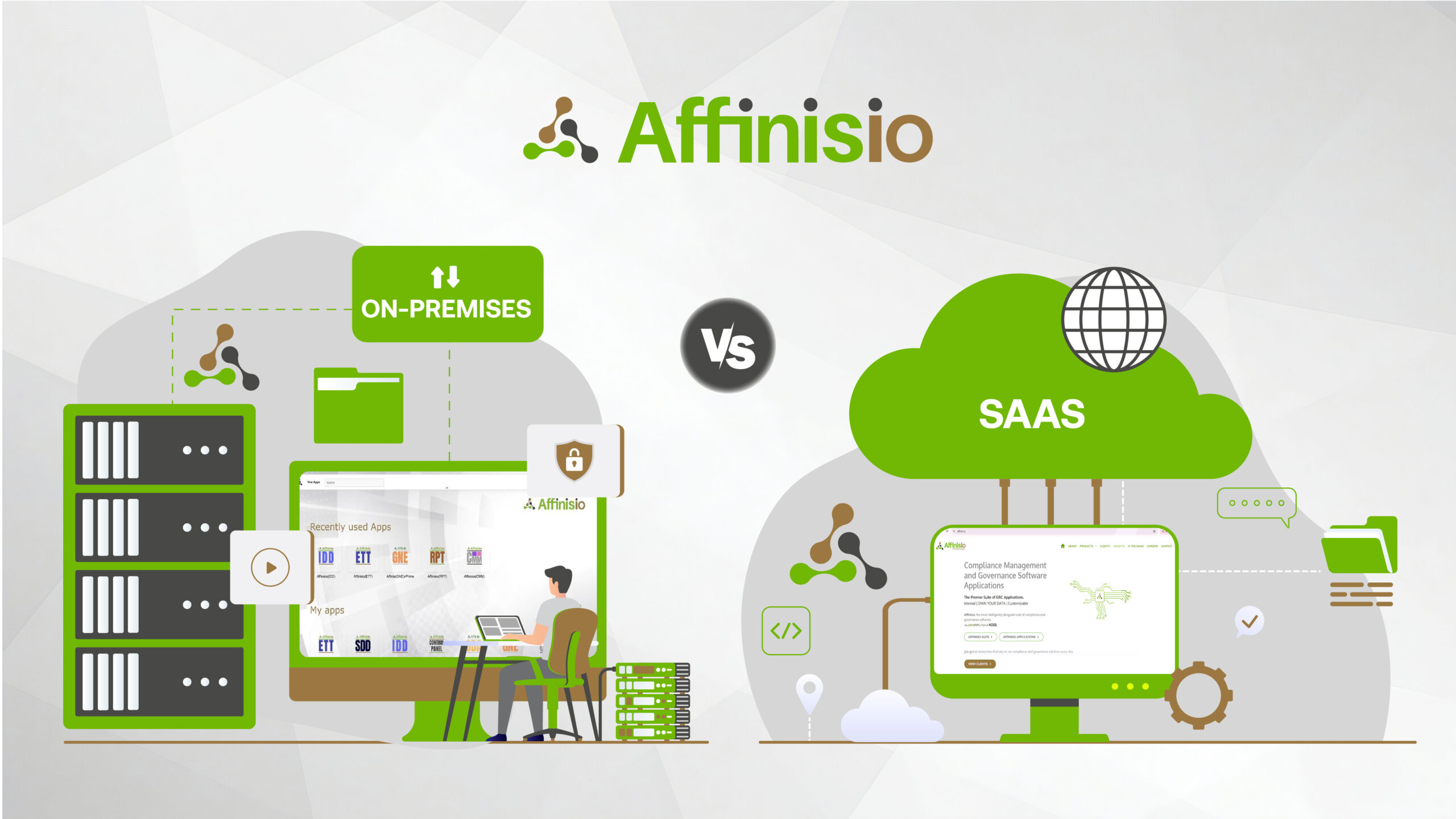
Understanding the Pros and Cons of ‘On-Premises’ and ‘SaaS’ (“Software as a Service“) deployments.
Understanding On-Premise Deployment
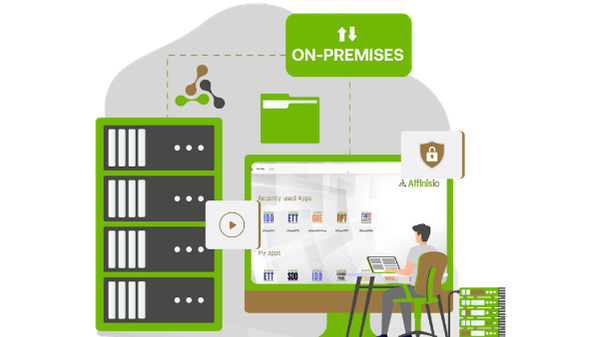
On-premise deployment refers to software that is installed and hosted within an organisation’s own IT infrastructure rather than on external owned or administered cloud server.
The deployment could be to either (1) a physical server or (2) an on-cloud instance commissioned and owned by the organisation from an external provider such as Microsoft’s Azure or Amazon Web Services.
This approach gives organisations direct control over their systems, data storage, and security policies. This level of control is essential for organisations operating in highly regulated sectors, including banking, financial services, listed entities, intermediaries, and capital markets, enabling them to OWN THEIR DATA for critical systems such as risk, compliance or payments systems,
Understanding SaaS Deployments
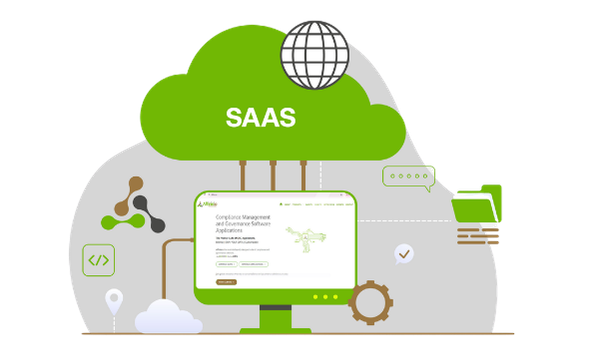
SaaS deployment is a software delivery model where applications are hosted by a service provider and accessed by customers through the internet. Instead of deploying systems internally, companies access the platform through the internet while the provider manages the infrastructure, maintenance, and updates.
SaaS platforms operate in a ‘shared cloud’ instead of an ‘owned’ environment, which means the vendor manages the underlying infrastructure and determines update cycles, architecture changes, and certain platform capabilities.
A Quick ‘Side-by-Side‘ Comparison
| Factor | On-Premises | SaaS |
|---|---|---|
| Data Ownership | Data remains within organisation environment | Data hosted on vendor-managed cloud. |
| Infrastructure Control | Full control over servers, storage, OS, databases, and network layers. | Infrastructure managed by vendor/cloud provider. |
| Security Architecture | Can run in restricted private networks. | Standardised vendor-managed security. |
| Customisation | Deep workflow and integration customisation possible. | Customisation mostly within preset configurations. |
| Compliance & Residency | Easier to demonstrate data residency and sovereignty. | Depends on cloud region and provider. |
| Network Dependency | Works within local infrastructure. | Requires stable internet connectivity. |
| Performance | Predictable performance on internal network. | May vary with connectivity. |
| Update Control | Organisation coordinates update schedule. | Vendor manages updates. |
| Environment | Dedicated deployment. | Typically, multi-tenant environment. |
How are On- Premises Deployments Better than SaaS?
Let’s briefly review the benefits of On-Premises Deployments over SaaS (see also the benefits of SaaS over On-Premises Deployments below).
Complete Control Over Infrastructure & Data
Systems containing extremely sensitive information, like trading data, employee details, sensitive transactional data, unpublished price-sensitive information (UPSI), risks and controls procedures, authorisations or business intelligence and secrets require complete protection and control. Protecting this data is not only a technical requirement but also often a regulatory obligation. The regulatory obligations may be ‘explicit’, such as in the case of Structured Digital Databases as required by SEBI or ‘implicit’ as outlined in a large number of regulatory prescriptions by regulators RBI, SEBI, IRDA or others.
Stronger Regulatory Compliance
Regulators across global markets increasingly emphasise transparency, auditability, and data traceability. Organisations must demonstrate that their compliance systems are secure, reliable, and capable of supporting regulatory audits.
Deep Customisation for Complex Workflows
Every organisation operates with unique governance structures and compliance procedures. Standardised systems often fail to fully capture the complexity of enterprise processes. While SaaS platforms offer basic configurable options, deeper customisation is sometimes limited because the platform must support multiple customers within the same architecture to retain their commercial edge. On-premises platforms enable deep customisation to align with specific organisational requirements. Organisations can customise:
- Integrations with other internal/ external systems,
- Compliance workflows and approval processes,
- Risk management frameworks and reports,
- Home country or head office regulatory structures,
- Disclosure and reporting structures,
- User access hierarchies and internal governance policies
Strong Security Isolation
One of the key advantages of on-premises deployments is the ability to run application systems within restricted and controlled environments. Organisations can deploy platforms within private networks or isolated infrastructure environments that are not shared with other companies while also controlling accesses within the company. The reduced exposure associated with multi-tenant environments allows organisations to apply their own security, threat detection, and access control systems. For companies handling confidential, internal or sensitive data, this isolation provides a critical benefit.
Operational Control and Performance Optimisation
Another key advantage of on-premise deployments is performance control. Organisations can allocate dedicated infrastructure resources, optimise system configurations, and ensure consistent performance across departments. This level of control allows IT teams to fine-tune system capacity and operational stability while reducing the already lower latency for internal users.
Long-Term Risk Management
Organisations must ensure that their compliance platforms can evolve alongside changing regulations, operational needs, and governance standards. When compliance systems depend entirely on external platforms, organisations may face limitations in configuration controls, enhancements and system upgrades. On-premise deployments allow enterprises to maintain strategic control over their technology, significantly reducing dependency on external vendors.
How is SaaS Better than On-Premises Deployments?
Having reviewed the benefits of On-Premises Deployments over SaaS, let’s go through the benefits of SaaS over On-Premises Deployments for the full picture.
Lower Upfront Investment
One of the most immediate benefits of SaaS is the reduced initial cost of deployment. Organisations do not need to invest in hardware, servers, or large infrastructure setups. Most SaaS platforms operate on a subscription-based model where costs are distributed monthly or annually.
Faster Deployment and Implementation
SaaS platforms are typically ready to use within hours or days. Since the infrastructure is already available, organisations do not need to provision virtual machines, make major firewall changes, or redesign network architecture.
Minimal Maintenance Responsibility
In a SaaS model, the vendor manages system maintenance, infrastructure monitoring, updates, and performance optimisation. This reduces the operational burden on internal IT teams.
On-Demand Scalability
SaaS platforms allow organisations to scale users, storage, and computing resources as required, making them suitable for growing or dynamically changing businesses.
Global Accessibility and Mobility
Because SaaS platforms are accessed through the internet, they are available from multiple locations and devices, supporting remote teams and multi-branch operations.
Continuous Innovation and Updates
SaaS providers regularly introduce new features, enhancements, and integrations. These updates are delivered automatically, helping organisations stay current with modern capabilities.
Advantages Of 
Affinisio’s On-Premises Deployments give you the best of both worlds.
Affinisio’s on-premise deployment model helps organisations maintain clear control over system logs, access permissions, and compliance workflows. The Affinisio suite of Governance Risk and Compliance applications provide the option for fully on-premises deployments to ensures that organisations retain full ownership of their data. Information, data, ownership remain fully within internal to the using organisations which can implement their own protocols, standards and controls.
AT THE SAME TIME, Affinisio provides the benefits of faster deployments (oftentimes within 2 days), while providing controlled support to minimise maintenance obligations by managing system maintenance and updates to reduce the operational burden on internal IT teams. With extreme scalability built-in, Affinisio is also accessible globally across form-factors with controls in the hand of the organisation supporting remote teams and multi-office operations. With regular new feature updates and enhancements Affinisio’s On-Premises deployment is designed to give you the best of both worlds.
What’s more, organisations seeking greater control on Infrastructure cost can also opt to deploy Affinisio on a SaaS model.