Conflict Check and Clearance Software for Law, Accounting and Consulting Firms: The Conflicts Clearance Compliance Centre
Affinisio(CCC) is the completely integrated application for compliance management of corporate conflicts of interest – get pre-checks, flags, assessments, reviews; audit trailed and evidenced to resolve potential conflicts of interest – real and perceived.


Conflicts of Interest: Your Central Clearance Hub and Compliance Software
Centralised oversight and screening across every client, matter and engagement — on the firm’s own infrastructure, so the record of who was screened and what was decided stays in your custody.
CCC
(Compliance Officers)
Quick, central conflicts clearances with policy guidance built in, so you can raise a request, get an answer, and get back to the engagement, the delivery and the revenue.
CCC
(Employees)
Law Firms
Affinisio(CCC) is conflict check and clearance software built for the way law firms actually work — clients, matters, opposing parties and the people who join you, all screened against one record.
Some conflicts are managed rather than declined. Ethical walls are recorded against the matter and the individuals they cover, from the date they take effect, so the firm can show what was put in place, when, and on whose authority.
Screening happens at intake, before the matter is opened and before time is recorded against it. The parties, the matter and the reason for each flag go to the person who has to decide — so a conflict surfaces while it can still be acted on cleanly.
Conflicts do not only arrive with new clients. Incoming partners and teams are screened against the firm’s current book before they join, so prior involvements are identified and resolved rather than discovered once a matter is already running.
Conflicts are tested against the firm’s own policy and the conduct standards applicable to it — including where those differ between practices, offices or entities within a group. Both real and perceived conflicts are raised for review.
Opposing parties are screened alongside the client, both resolved by identifier rather than by name or phonetic match. Group structures, promoter groups and subsidiaries are mapped, so a conflict two entities away from the named party still surfaces.
A conflict check is not a gate that says only yes or no. Most engagements clear outright, some proceed with mitigation and some are declined, each with its reasoning and decision-maker recorded. Mitigation is then re-affirmed over time, not assumed to hold.
Clearance decisions are recorded as they were made, with the information that was available at the time.
So the firm can act quickly on new instructions, and demonstrate afterwards exactly how the decision was reached.
Accounting and Consulting Firms
Affinisio(CCC) is conflict check and clearance software for accounting and consulting firms — acceptance, continuance, independence and the network you belong to, all screened against one record.
Assurance, advisory, valuation and taxation do not carry the same conflict judgement. Each engagement is routed to its practice lead, who with information barriers in place across the firm is often the only person positioned to see the wider picture.
Non-audit work is screened against the firm’s audit relationships and the wider group each client belongs to, so a proposal to a subsidiary of an audit client is recognised as such before it is accepted rather than after the work has begun.
A relationship that has ended can still constrain what the firm may take on. Concluded engagements stay on the record with their end dates, and any cooling period the firm applies runs from that date, so the constraint lapses when it should and not before.
A conflict can sit outside the firm’s own book — in a member firm, an affiliate or a correspondent in another market. Network relationships and the engagements shared with the firm are screened alongside its own, so the check does not stop at the door.
A conflict may be a matter of judgement; an independence breach is not. Both are tested against the firm’s own policy, and the system separates the two so a judgement call is never treated as a breach, nor a breach as a judgement call.
Inspection and internal quality review both ask the same question: what did the firm know when it accepted this engagement? The clearance record answers it directly, holding the position as at the decision date rather than as the data reads now.
Acceptance and continuance are tested against the same record, every time.
So independence questions are answered from evidence rather than from recollection.
Features
Conflicts Compliance: Automated, Central, Seamless, Proactive
Managing corporate conflicts is hard – hidden relationships, patterns, ethical risks, and manual checks often lead to delays, oversights and serious compliance pitfalls.
Affinisio(CCC) is your central solution for it all.
Every party resolved by identifier, every engagement screened before it opens, and every clearance decision evidenced with point-in-time snapshots.

Conflicts Clearance – Centralised
One record for every check the firm runs
Every conflict check the firm runs — across clients, matters, offices and practice areas — is held on one record. Nothing sits in a partner’s inbox, a spreadsheet or a local file, so the position on any client or matter is the same wherever it is asked.
Entity Resolution – By Identifier, Not by Name
Universal identifiers replace phonetic and alias matching
Names are unreliable. Spellings vary, transliterations differ, and the same person appears three ways across three records. Parties are resolved by universal identifiers, for entities and individuals alike, so a match is a fact rather than a probability.


Group Structures – Mapped with Leading Providers
Beyond the named party to the group behind it
A conflict rarely sits with the party you were given. Group structures, promoter groups and subsidiaries are mapped so the check reaches the entities behind the name, using corporate-tree data from leading data providers alongside the firm’s own records.
Conflict Identification – Flagged, Classified, Routed
Classification is automatic; the judgement is not
A flag on its own is noise. Each potential conflict is classified by type and routed to the person entitled to decide it, with the parties, the overlap and the financial, ethical and business implications attached. Severity is a judgement, not a calculation.


Conflicts Review Standards Made Consistent
Consistency should not be reliant on who the assessment lands with
A review that takes a week is a review that gets bypassed. The same policy is applied whatever the size of the matter, so a routine engagement clears quickly and a difficult one gets the attention it needs without either waiting on the other.
Conflict Clearance – Built Into Time and Billing
No sign-off code, no time booked, no bill raised
No time can be booked and no bill raised without a sign-off code from Affinisio(CCC). The control is baked into the commercial process itself with a two-way sync, so an engagement cannot proceed on long familiarity with a client in place of a completed check.

One Data Layer Across the Affinisio Suite
Engagements passed here carry through the suite
With a unified data layer, a conflict cleared through Affinisio(CCC) moves seamlessly to the next set of obligations. An accepted engagement results in restricted personal account trading in Affinisio(ETT) without the need to re-enter it or reconcile two systems.
Reciprocal Relationships
Every party described correctly, whichever side of a matter it sits on
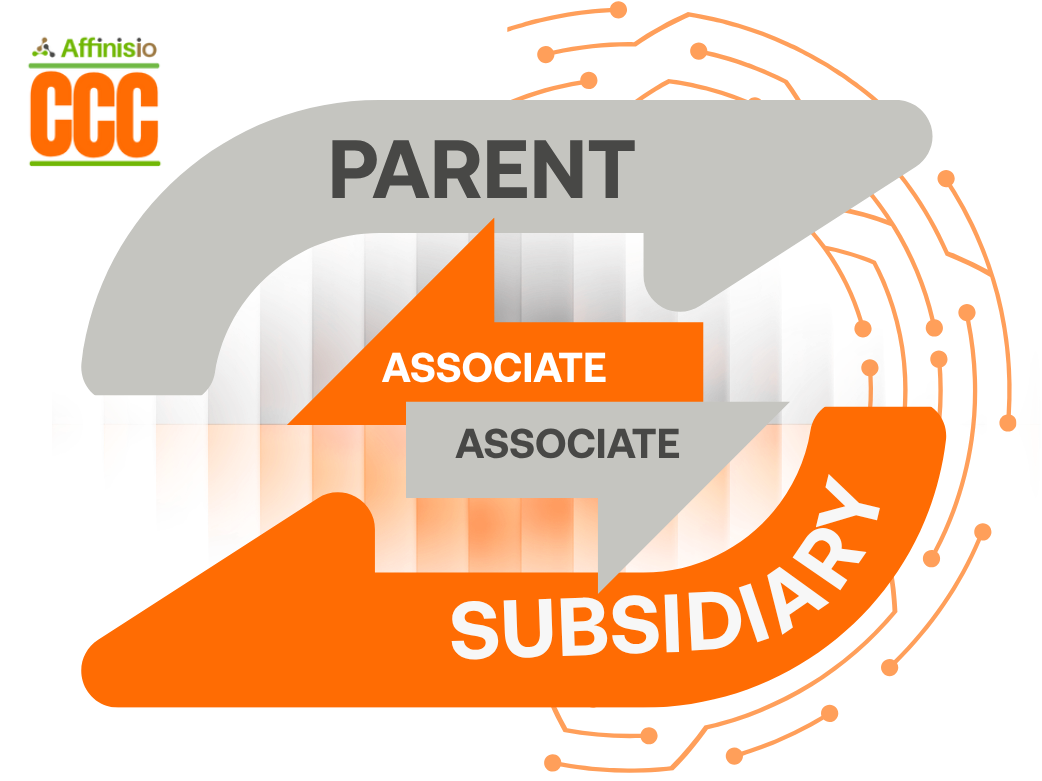
Relationships are entered once and mirrored automatically, holding the description each party would use for the other. ‘We act for their parent’ and ‘they are our client’s subsidiary’ mean the same thing and are recorded correctly from either side, so either entity can sit on either side of a matter and be described correctly in every conflict check.
Auto-Created Group Hierarchies
Complex ownership chains, linked and organised automatically
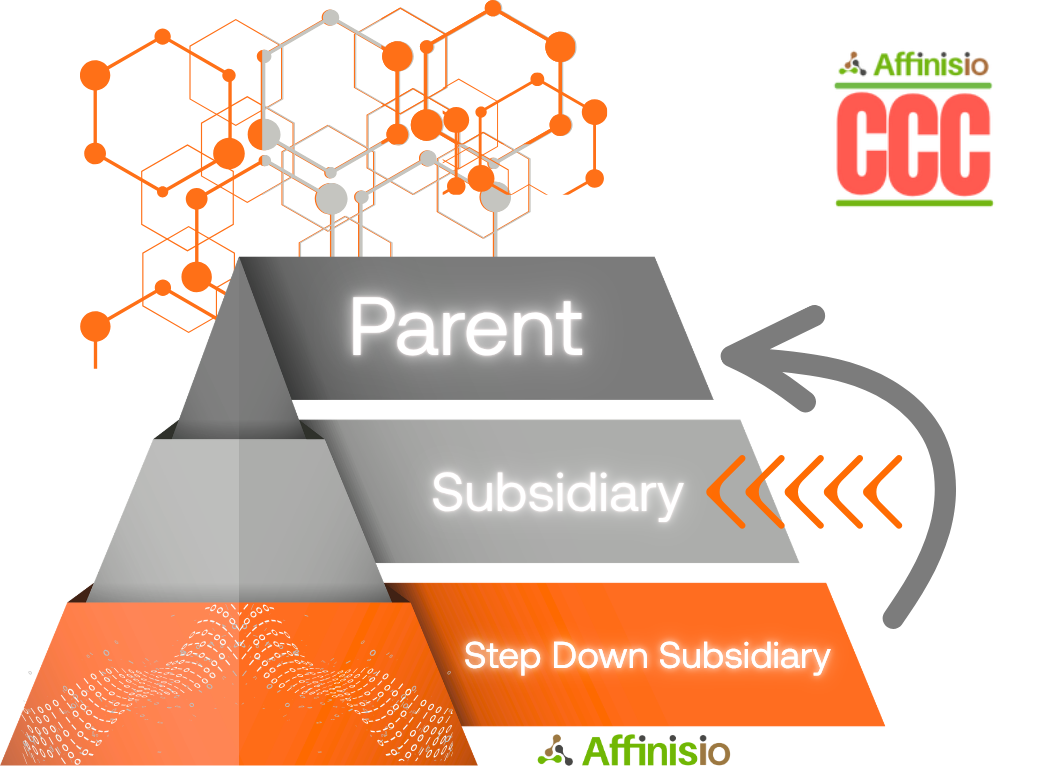
From the relationships the firm enters, Affinisio(CCC) builds the full group chain automatically. For example, a client’s third step-down subsidiary can be auto linked to the parent when the second is added, so a conflict check reaches the whole group behind the named party.

Affinisio(CCC) integrates with Dun & Bradstreet’s Direct+ DataBlocks APIs to build ownership chains and group structures.
Dun & Bradstreet data is licensed by Dun & Bradstreet directly to the customer under a separate agreement between the customer and Dun & Bradstreet. Affinisio does not resell, supply or license Dun & Bradstreet data. Dun & Bradstreet, D&B and the D&B logo are trademarks of Dun & Bradstreet and are used under licence. Their use does not constitute endorsement, sponsorship or certification of Affinisio or its products by Dun & Bradstreet. Affinisio is not an agent, reseller, distributor or representative of Dun & Bradstreet.

More than a software application, AFFINISIO IS YOUR COMPLIANCE AND GOVERNANCE CENTRE.
All applications in the Affinisio Suite integrate seamlessly with each other and are backward and forward compatible. Data is shared amongst the applications whenever you upgrade.


Get AFFINISIO now!
Have questions? Connect with the Affinisio team.
Faq
Affinisio(CCC) FAQs
What is Affinisio(CCC)?
Affinisio(CCC) is conflict check and clearance software for law, accounting and consulting firms. It screens new clients, new matters and new engagements before they open, resolving every party by universal identifier rather than by name, and mapping the group structures behind them. Where a conflict is found it is classified, routed to whoever is entitled to decide it, and recorded with the reasoning and the decision-maker. It is the only India-based and headquartered conflicts clearance product, deployable fully on your own infrastructure, with data residency and complete support within India.
Who is Affinisio(CCC) designed for?
Three kinds of firms use Affinisio(CCC). Law firms screen clients, matters and opposing parties, and the conflicts that arrive with lateral hires and incoming teams. Accounting and audit firms use it at engagement acceptance and continuance, and for independence questions where non-audit work is proposed to an audit client or a company in its group. Consulting and advisory firms use it where mandates compete across service lines. Inside each, the compliance and risk function uses it for oversight and evidence, while fee earners use it to raise a request and get a decision.
Does Affinisio(CCC) resort to phonetic or fuzzy name matching?
No. Affinisio(CCC) matches on identity rather than likeness, and the discipline is set at commissioning rather than applied case by case. A range of alternative identifiers is accepted so that legal and natural persons can be resolved in any jurisdiction — for example, PAN in the Indian jurisdiction, and the equivalent registered identifier elsewhere. Approximate matching fails in two directions: it returns matches that are not matches, and it misses matches that are — and a conflicts record built on it carries both errors forward for as long as the record is kept.
How are entity and individual identifiers protected?
An individual’s identifier is personal data, and Affinisio(CCC) treats it as such. The system runs on the firm’s own infrastructure, so identifiers are held where the firm holds them and are not sent elsewhere to be matched or interpreted. Access is restricted to the people entitled to it, and every access is recorded alongside the clearance it belongs to. Because matching is done on identity rather than likeness, there is no processing step that requires an individual’s identifier to leave the firm at all. Where the Digital Personal Data Protection Act applies, that architecture is what allows a firm to answer questions about custody with a description of its own systems rather than of a vendor’s.
Does Affinisio(CCC) handle insider trading compliance?
No. Affinisio(CCC) is conflict check and clearance software, and it does not itself perform insider trading compliance, which belongs to Affinisio(ETT), a separate product in the same suite. All applications share a unified data layer, which is what makes the connection real and seamless rather than an integration promise: a conflict recorded in Affinisio(CCC) is passed on to Affinisio(ETT) to track prohibitions that arise with an accepted engagement — no re-keying and no reconciliation between two systems. A firm can take either application on its own, or both together.
Can Affinisio(CCC) be deployed on-premises, and where is client and party data held?
Yes, and for most firms it is the default rather than a variation. Affinisio(CCC) installs inside the firm’s own environment, so the application, the party register and the full clearance history sit on infrastructure the firm already owns and governs. Client and party data is held there and only there — it is not mirrored to a vendor platform. Where corporate-tree data is used, the firm’s own instance queries public ownership records by identifier and receives the structure back; the request carries no engagement, matter or client information, and nothing of the firm’s own position leaves with it. Where a firm prefers a hosted arrangement, that is available as well, with the same product and the same records. The choice belongs to the firm, and it does not change what the software does.
Which markets does Affinisio(CCC) serve?
Affinisio(CCC) is built to a universally applicable global framework. It sits across professional-conduct standards, firm policy set by the nature of the firm’s business, and the regulatory standards applicable to a group or to one of the firms within it. Its coverage is therefore defined by where firms operate rather than by one regulator’s writ. Affinisio(CCC) serves India, Australia, New Zealand, South Africa, the United Kingdom, Sri Lanka, Ireland, Singapore, Malaysia, Saudi Arabia, the United Arab Emirates and the United States of America as its primary markets, and can also service organisations in Canada, Jamaica, Bermuda, The Bahamas, the Cayman Islands, Switzerland, the Netherlands, Malta, Cyprus, Hong Kong SAR, the Philippines, Fiji, Nigeria, Kenya, Ghana, Mauritius, Botswana, Namibia, Zimbabwe and Uganda. Affinisio(CCC) is deployable globally.
Why are prior conflicts clearances essential?
Why are conflicts approval through so crucial?
Can you give me examples of conflicts of interests?
Why do conflicts reviews take so much time?
What’s New
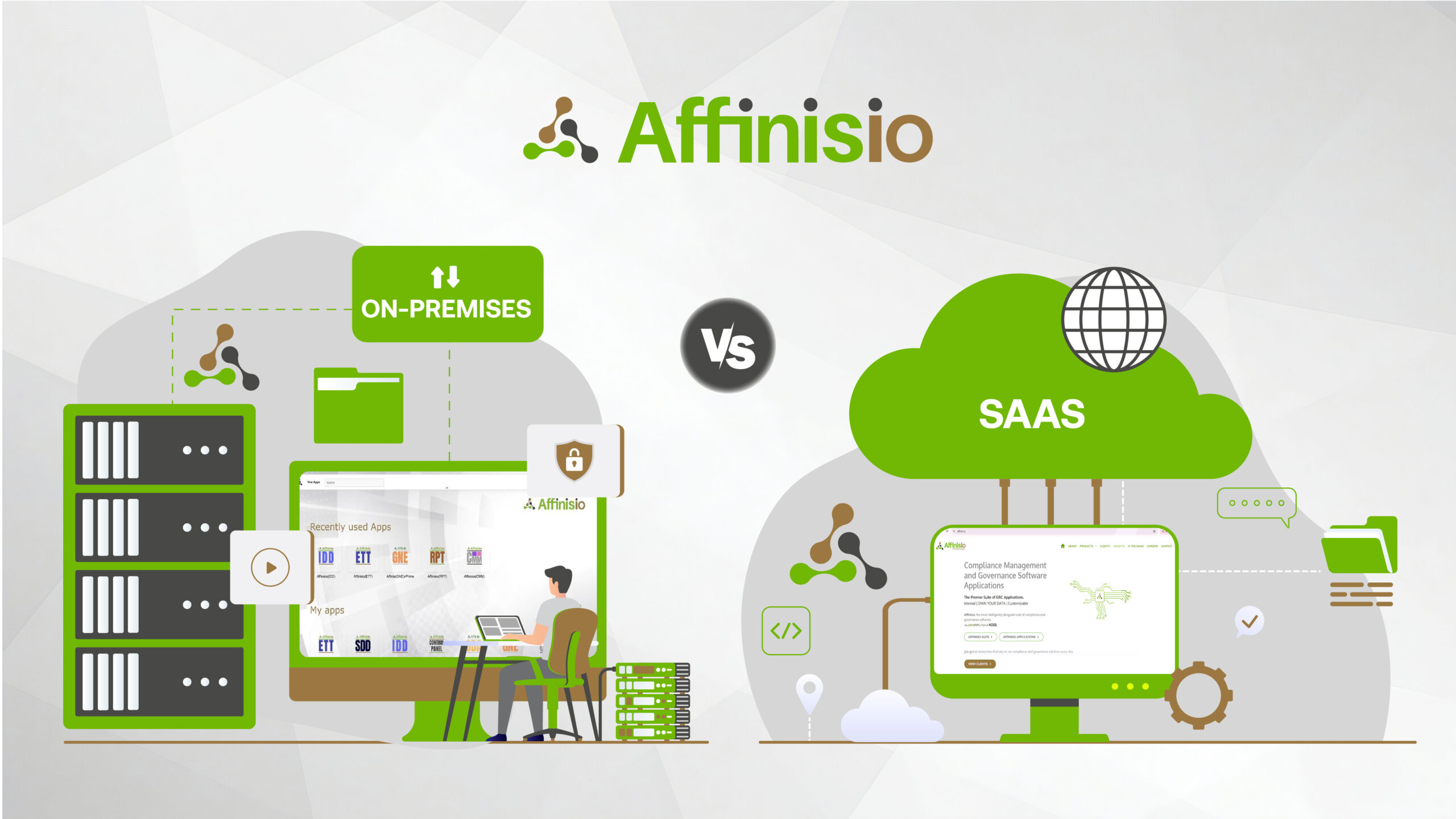
On-Premises vs SaaS – The Primer

Conflict Clearance: What is it and Who needs it

Conflict Compliance Checks – The Shield Every Business Needs

