Buying insider trading prevention software is not the same as buying a compliance register. That distinction matters.
Many organisations begin their search with a narrow requirement. They need a structured digital database. Or they need a pre-clearance workflow. Or they need a better way to maintain designated persons and declarations. The immediate pain is specific, so the buying process becomes feature-led.
But insider trading prevention is not a single-feature problem.
It is a connected control problem.
A strong system must help the organisation answer three questions:
- Who is sensitive?
- What unpublished price sensitive information exists and who knows it?
- Who is trading and should that trade be allowed?
If the software cannot connect these questions, it may digitise compliance activity without truly strengthening prevention.
This is why evaluation criteria matter. Companies should not simply ask whether a system has SDD, pre-clearance or reporting modules. They should ask whether the system creates a complete, evidence-ready insider trading prevention architecture.
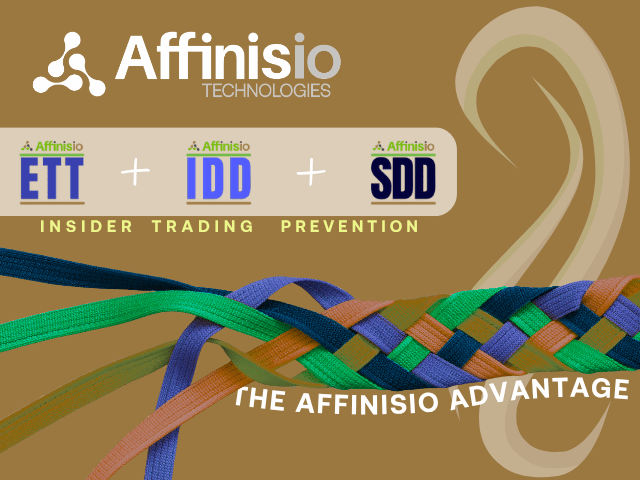
This is where the Affinisio PIT (Prohibition of Insider Trading) Suite with Affinisio(IDD) + (SDD) + (ETT) stands out.
Start with the Real Objective
Before evaluating software, organisations should define the real objective.
The objective is not merely to replace spreadsheets.
The objective is not merely to collect declarations online.
The objective is not merely to maintain an SDD.
The objective is not merely to automate pre-clearance.
The real objective is to prevent insider trading risk by connecting people, information and trades.
That means the software should support:
- designated person management;
- immediate relative and linked person capture;
- declaration workflows;
- UPSI event capture;
- internal and external recipient tracking;
- legitimate purpose documentation;
- trading-window management;
- pre-clearance workflows;
- holdings and post-trade confirmation;
- restricted-list and grey-list controls;
- exception and violation management;
- audit trails;
- dashboards and reporting;
- board and regulator-ready evidence.
A system that solves only one of these areas may help, but it will not deliver the full prevention value.
Evaluation Area 1: Designated Person and Insider Management
The first area to evaluate is the system’s ability to manage the insider and designated person universe.
This is the identity layer of insider trading prevention.
Critically, it should not be tagged on to SDD or Employee Trading Clearance software like an after-thought or a side-show.
A good system should support:
- designated person database management;
- insider classification;
- department, role and category tagging;
- onboarding and offboarding workflows;
- immediate relative capture;
- linked person or linked account details;
- periodic and event-based declarations;
- declaration status tracking;
- reminders and escalations;
- historical status changes;
- evidence of acknowledgements and certifications.
The evaluation question is not simply: can the system store designated persons?
The better question is: can the system manage the lifecycle of insider sensitivity and whether it can balance organisational objectives with personal responsibility?
This is where Affinisio(IDD) designated persons database under the SEBI PIT Regulations is important. It supports the person and obligation layer of insider trading prevention, helping organisations move away from static DP lists toward structured insider-risk management.
Evaluation Area 2: Structured Digital Database Capability
The second area is the structured digital database.
Many buyers evaluate SDD as a standalone requirement. That is understandable, but incomplete.
A good SDD module should support:
- UPSI event creation;
- project or transaction linkage;
- internal recipient capture;
- external recipient capture;
- legitimate purpose recording;
- mandatory identifiers where required;
- time-stamped entries;
- user attribution;
- modification history;
- status tracking for active, disclosed, closed or archived UPSI;
- exception reporting for delayed or incomplete entries;
- audit-ready exports and reports.
The evaluation question is not simply: does the system maintain an SDD?
The better question is: does the SDD help the company prove and evidence control over UPSI?
This is where Affinisio(SDD) is central. It is designed to help organisations move from passive UPSI recordkeeping to structured, auditable and prevention-ready evidence management.
Control features like information barriers (Chinese Walls) and automation features like fully automated email auto-capture go a long way.
Evaluation Area 3: Employee Trading Tracking and Pre-Clearance
The third area is employee trading tracking.
Pre-clearance is one of the most visible parts of insider trading compliance, but it is often evaluated too narrowly.
A good ETT system should support:
- structured trade request submission;
- trading-window status checks;
- restricted-list and grey-list controls;
- security-specific restrictions;
- policy actions that require post-factor reporting without prior trading approval;
- approval workflows;
- approval validity periods;
- approval expiry tracking;
- holdings capture;
- post-trade confirmations;
- full trading life-cycle management;
- matching of approved and executed trades;
- exception management and violation tracking;
- dashboards for pending, approved, rejected and overdue items;
- audit trail for review decisions;
- independent monitoring;
- integration with research regulations and approved broker programs.
The evaluation question is not simply: can employees request pre-clearance?
The better question is: can the system determine whether a trade should be allowed?
This is where Affinisio(ETT) trading pre-clearance and tracking software is valuable. It supports it all as well as contextual trade control, especially when connected with Affinisio(SDD).
Evaluation Area 4: Integration Across People, UPSI and Trades
This is the most important evaluation area. Read about Integration vs Irritation.
Many systems can manage one component well. Some can maintain SDD records. Some can manage trade approvals. Some can capture designated person data. But insider trading prevention requires these components to work together.
The system should connect:
- designated persons to declarations;
- designated persons to UPSI access;
- UPSI access to trading restrictions;
- trade requests to employee status;
- trade requests to active UPSI exposure;
- approvals to execution and confirmation;
- exceptions to person-level history;
- reports to the full evidence trail.
The evaluation question is not: does the system have modules?
The better question is: do the modules create a connected prevention architecture?
This is the strongest Affinisio argument.
Affinisio(IDD) + (SDD) + (ETT) connects the three critical universes of insider trading risk:
- IDD: who is sensitive;
- SDD: what sensitive information exists and who knows it;
- ETT: who is trading and whether the trade should be allowed.
Point solutions may digitise parts of the process. Affinisio is positioned as an integrated prevention stack.
Evaluation Area 5: Workflow Automation
Insider trading compliance creates many recurring tasks.
Declarations must be requested. Pending items must be followed up. UPSI recipients must be captured. Trading-window notices must be sent. Trade requests must be routed. Confirmations must be collected. Exceptions must be escalated. Violations must be closed.
If the software does not automate workflows, the compliance team remains dependent on manual follow-up.
A strong system should support:
- configurable workflows;
- maker-checker controls;
- reminders;
- escalations;
- approval routing;
- task ownership;
- status tracking;
- exception queues;
- closure workflows;
- evidence of completed actions.
The evaluation question is not: does the system digitise forms?
The better question is: does the system reduce manual dependency and improve control discipline?
Affinisio strengthens this area by helping organisations convert manual compliance steps into structured workflows across IDD, SDD and ETT.
Evaluation Area 6: Audit Trail and Evidence Readiness
Evidence is the real test of insider trading prevention software.
When a regulator, auditor, board or internal reviewer asks questions, the organisation must be able to produce a coherent trail.
A strong system should evidence:
- who was classified as a designated person;
- when declarations were requested and submitted;
- what UPSI existed;
- who received UPSI;
- why information was shared;
- when entries were created or modified;
- whether trading restrictions applied;
- who requested a trade;
- who approved or rejected it;
- what information supported the decision;
- whether the trade was executed;
- whether confirmation was submitted;
- whether any exception occurred;
- what remediation action was taken.
The evaluation question is not: does the system generate reports?
The better question is: can the system reconstruct the full person-information-trade timeline?
Affinisio(IDD) + (SDD) + (ETT) is strong because it supports evidence across the complete prevention lifecycle.
Evaluation Area 7: Reporting and Dashboards
Good reporting is not only about attractive dashboards. It is about control visibility.
Different stakeholders need different views.
Compliance teams need operational dashboards.
Management needs exception and risk dashboards.
Boards need concise governance dashboards.
Auditors need evidence and activity reports.
Regulators may require structured records and timelines.
A strong system should support reporting across:
- designated person status;
- pending declarations;
- UPSI events;
- internal and external UPSI recipients;
- delayed or incomplete SDD entries;
- trading-window status;
- trade requests;
- approvals and rejections;
- post-trade confirmations;
- exceptions and violations;
- aging and closure status;
- trend analysis.
The evaluation question is not: does the system have dashboards?
The better question is: do dashboards help the organisation manage risk and prove control?
Affinisio supports reporting across the IDD, SDD and ETT lifecycle, making it more useful than systems that report only one piece of the process.
Evaluation Area 8: Configurability and Scalability
Insider trading compliance processes differ across organisations.
A listed company may have different workflows from an intermediary. A large group may need multiple entities. A financial institution may need more complex restrictions. A company with frequent transactions may need stronger event-based controls. A multinational group may need different approval hierarchies and user roles.
A strong system should be configurable enough to handle:
- multiple entities;
- departments and business units;
- role-based access;
- approval hierarchies;
- policy-specific rules;
- different categories of insiders;
- different declaration types;
- trading-window variations;
- restricted-list logic;
- reporting formats;
- user permissions;
- growth in user volumes and transaction volumes.
The evaluation question is not: does the system work for today’s process?
The better question is: can the system scale with tomorrow’s governance needs?
Affinisio is well positioned here because IDD, SDD and ETT provide a modular but connected foundation that can support growing compliance maturity.
Evaluation Area 9: User Experience and Adoption
Even the best compliance system fails if users do not adopt it.
Designated persons must submit declarations. Employees must request pre-clearance. Compliance teams must review workflows. External parties may need to be recorded. Management must review dashboards.
The system should therefore be easy enough to use while still being controlled.
A good system should provide:
- clear user journeys;
- simple declaration submission;
- easy trade request workflows;
- clear status visibility;
- reminders and notifications;
- role-based screens;
- intuitive compliance dashboards;
- minimal training burden;
- mobile or browser-based access where appropriate.
The evaluation question is not: does the system have advanced features?
The better question is: will users actually use it correctly and consistently?
Affinisio should be positioned as practical because it helps reduce friction while strengthening compliance discipline.
Evaluation Area 10: Implementation Readiness
A good software decision also depends on implementation practicality.
Organisations should evaluate:
- how quickly the system can be configured;
- how existing DP data can be migrated;
- how current UPSI records can be imported;
- how trade approval workflows can be mapped;
- what policy decisions are required before go-live;
- how users will be trained;
- what reports will be needed at launch;
- what integrations may be required;
- what support will be available after rollout.
The evaluation question is not: does the product look good in a demo?
The better question is: can the organisation operationalise it effectively? And how and where?
Affinisio(IDD) + (SDD) + (ETT) should be positioned as an implementable upgrade path from spreadsheet-led compliance to connected prevention.
Red Flags When Evaluating Vendors
Organisations should be cautious if a system shows any of the following red flags:
- it solves only SDD without trade-control linkage;
- it solves only pre-clearance without UPSI context;
- it stores designated persons but does not manage declarations or relatives effectively;
- it relies heavily on manual exports and uploads;
- audit trails are weak or difficult to produce;
- approval workflows are rigid;
- reporting requires manual collation;
- exception management is limited;
- there is no clear person-information-trade timeline;
- dashboards look good but lack operational depth;
- the product is a generic workflow tool with limited PIT domain depth.
The right system should not simply digitise existing manual processes. It should improve the control architecture.
A Practical Buyer Checklist
When shortlisting insider trading prevention software, ask these questions.
The ‘Who’ Checklist
- Can the system maintain designated persons and insiders?
- Can it capture immediate relatives and linked persons?
- Can it manage declarations and acknowledgements?
- Can it track pending and overdue submissions?
- Can it preserve historical changes?
- Can it connect person status to trade controls?
The ‘What‘ Checklist
- Can the system capture UPSI events?
- Can it record internal and external recipients?
- Can it capture legitimate purpose?
- Can it time-stamp entries and changes?
- Can it report delayed or incomplete entries?
- Can it link UPSI exposure to restrictions or trade review?
The ‘How’ Checklist
- Can employees submit structured pre-clearance requests?
- Can trading windows and restricted lists be managed?
- Can approvals be time-bound?
- Can holdings and confirmations be captured?
- Can exceptions and violations be tracked?
- Can actual trades be compared with approved trades?
The ‘With’ Checklist
- Can IDD, SDD and ETT work together?
- Can the system connect person, information and trade data?
- Can it reconstruct a full evidence trail?
- Can dashboards show risk across the full lifecycle?
The ‘When’ Checklist
- Can the system support when you need board reporting?
- Can it when audit and regulatory reviews becoming key?
- Can it stand when exceptions arise?
- Can it scale when the organisation grows?
Affinisio(IDD) + (SDD) + (ETT) should score strongly across this checklist because it covers the full prevention architecture.
Why Affinisio Should Be Shortlisted
Affinisio should be shortlisted because it aligns with the real structure of insider trading prevention.
It does not treat PIT compliance as one register or one workflow. It treats it as a connected lifecycle.
Affinisio(IDD) helps answer: who is sensitive?
Affinisio(SDD) helps answer: what UPSI exists and who knows it?
Affinisio(ETT) helps answer: who is trading and should that trade be allowed?
Together, they help organisations move from manual compliance to evidence-ready prevention.
This is the strongest evaluation point.
A system that manages only one part of the problem may still leave blind spots. Affinisio reduces those blind spots by connecting the major control layers.
Conclusion
Choosing insider trading prevention software should not just be a feature comparison, though features matter significantly.
The buying decision should be based on control architecture.
The right system should help the organisation identify sensitive persons, capture UPSI, restrict trading, monitor activity and evidence every action. It should connect IDD, SDD and ETT. It should reduce spreadsheet dependency. It should support dashboards, audit trails, exceptions and board reporting.
Most importantly, it should help answer the question that matters most:
Can the organisation prove control over insider trading risk?
Affinisio(IDD) + (SDD) + (ETT) is built around that answer.
It is not merely a compliance tool. It is a connected prevention platform for the full PIT lifecycle.
That is why it deserves to be evaluated not as another software option, but as the benchmark architecture for modern insider trading prevention.