At the heart of every related party transaction management system lie a few critical and fundamental needs that are as complex to design as they are easy to list:
- Centralised, intelligent and continually updated repository of all Related Parties (entities as well as individuals for multiple levels)
- Omnibus approval management, tracking, utilisation and reporting.
- Identification of all transactions with every related party.
- Application of governance and disclosure norms.
- Creation of RPT reports.
…and here it where the standardised compliance diverges for every entity and group.
To complete the last mile compliance, three aspects are considered as part of the implementation, most of all specific to SEBI’s Listing Obligations and Disclosure Requirements:
– Internal operational preferences.
– Transaction identification logic (for integrations with SAP / other)
– Applicable SEBI-LODR structures (+ IND-AS, Company Law, RBI regulations etc).
Evolution of SEBI-LODR’s RPT regulations
Over the course of 2024 to 2026, you will be aware that Related Party Transactions (RPT) have evolved from another line item to manage to a high-stakes governance, operational, transactional tracking and reporting puzzle.
A continuing set of prescriptions, updates changes as well as regulatory action and penalties have revealed these stakes.
With the latest SEBI LODR (Listing Obligations and Disclosure Requirements) amendments and the mandatory Industry Standards now in full swing as of 2026, the “manual approach” isn’t just slow; it’s a liability.
Between scale-based materiality thresholds, the granular “Part A, B, and C” reporting requirements under SEBI LODR and the massive stream of penalties imposed, the margin for error has evaporated.
Navigating the “A, B, and C” of Related Party Transaction’s Industry Standards
SEBI Industry Standards for 25-26 have introduced a rather rigorous three-tier framework for info-sharing that is automated as part of implementation.
Consider the following aspects:
- Part A (the ‘Universal’ Requirements): The centralised repository of all related parties (entities and individuals) including multi-level relationships and ownerships as well as management control relationships, ensuring that when a transaction is proposed, all “basic details” as well as all relationships are pulled instantly.
- Part B (Transaction-Specific Disclosures): Auto-identifying the transaction types and prompting for specific rationale and pricing through the internal governance up to the Audit Committee including purpose and effect assessments. Whether it is (1) a typical current account transaction such as the sale of material or services, payment of license fees or similar or (2) a Capital account transaction or (3) a specific sub-category amongst those Capital account transactions or (4) a specific category of current account transactions like brand marketing fees with additional regulatory carve outs and other similar aspects so they can be automatically pre-identified for additional compliance treatment.
In summary, transaction considerations auto-segregate for Capital or Current account transactions, auto-classify Exempted, Simplified and Detailed disclosures per SEBI LODR norms and auto-classify transactions for Audit Committee or Shareholder Approval. Further, additional compliance prompts for specific types of capital account transactions such as ICD, Loans, Investments etc are triggered (similarly for additional compliances for specific types of current account transactions such as brand loyalty payments etc). - Part C (Additional Materiality Disclosures): Auto-triggering “Part C” requirements when transactions cross certain criteria or materiality levels.
The “Materiality” Math for Related Party Transaction Compliances
The regulatory landscape for RPT in India has undergone a seismic shift between 2024 and 2026. Staying compliant is no longer about simple year-end audits but about real-time, multi-layered governance. The most significant change in the last two years is the move away from the “one-size-fits-all” approach to materiality. The materiality elements apply to who governs the transactions as well as the minimum information required to be disclosed at each point under different areas and aspects.
The erstwhile simple “₹1,000 crore or 10%” rule no longer matters. With scale-based thresholds, materiality limit depends on specific consolidated turnover bracket. Calculating these cut-offs automatically with embedded logic is the first step to decide the materiality levels for the governance and disclosure level rules applicable.
The implementation approach for SEBI LODR matches (1) cut-offs applicable to your company (2) related party structures (3) governance set-up of your company (4) ERP used by your company to give you complete automation.
The ERP/SAP and RPT Integration Advantage.
A compliance tool is only as good as its data. By implementing a direct mapping with SAP transaction codes, the tool eliminates the “identification lag.” It doesn’t wait for the month-end close to tell you there’s an RPT; it identifies the party at the point of entry, ensuring Auto-Governance is applied before the ink is dry, including two-way integration.
Related Party Transaction Compliance in the Digital Age
SEBI’s recent enforcement actions (like the Linde India or Reliance Home Finance orders) have established yet again the permanent departure from the traditional approach.
By using an automated tool that automates, tracks, prompts as well as generates all three parts of SEBI LODR reports and tracks Omnibus approval utilisation Affinisio(RPT) moves you from “checking boxes” to “active oversight.”
Affinisio doesn’t just “install” software, we finalise the implementation based on your specific governance set-up, ERP environment, and unique related party structures, ensuring the tool fits your company like a glove.
And this applies beyond simply SEBI-LODR Compliances.
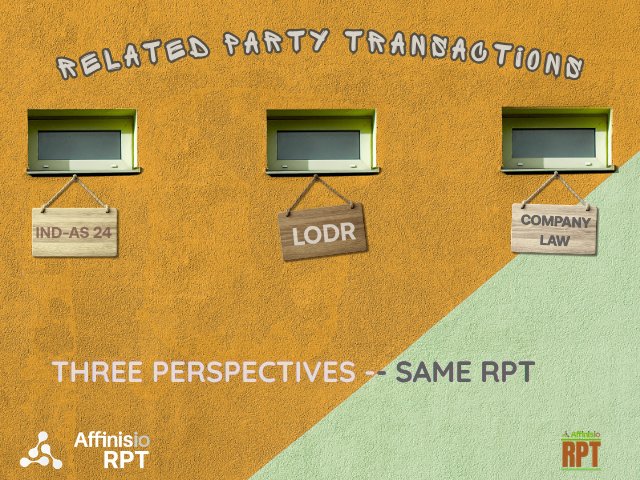
One Related Party Transaction, Multiple Sets of Compliances
A single transaction with a related party often triggers multiple different sets of rules. Mapping these manually is where danger lies. Affinisio(RPT) related party transaction compliance reporting and consolidation software creates a unified identification logic for all compliances.
We have already gone through SEBI-LODR above, so now let’s now review the interaction with Companies Act and IND-AS.
- Companies Act, 2013 with the focus on the nature of the contract and whether it is at “Arm’s Length” and in the “Ordinary Course of Business“.
- SEBI LODR with its primary focus on protecting the interests of the shareholders including minority shareholders.
- Ind AS 24 – accounting standards with the focus on financial transparency and disclosure (and which holds the broadest definition of a “Related Party,” up to and including family members).
- Implementation also addresses additional nuances for subsidiary governance by the parent company’s Audit Committee based on thresholds, governance relating to material modifications and RBI Regulations for entities lending to related parties (dealing with credit risk mitigations and conflict of interest) add another layer to complete the implementation scenarios.
One transaction from your ERP gets auto-treated, auto-classified and auto-reported under separate standards.