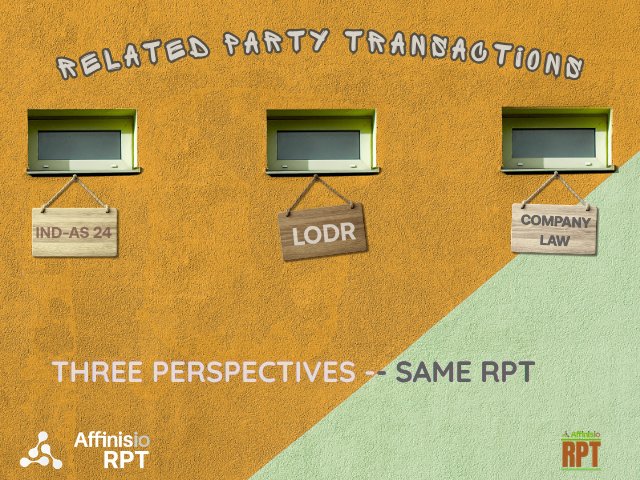
A related party transaction would be one that may transfer resources, services or obligations between a company and a party related to it, whether or not a price is charged. It may be a single transaction or a series of them, and it may run between entities in the same group, between a parent and its subsidiaries, or through individuals and entities that are related directly or indirectly.
In India, related party transaction regulations do not come from a single source. Many different regulatory and statutory provisions deal with related party transactions. After all, related party transactions that are ill-intentioned are just another way to slip value away from one source unfairly, immorally or illegally to another source (the oldest of motivations). Value can be diverted away from shareholders, tax and statutory authorities, creditors or lenders or anyone else and therefore multiple regulations exist to prevent them, all with a dedicated scope, intent and end purpose.
Three sets of rules look at the same transaction: the Securities and Exchange Board of India (Listing Obligations and Disclosure Requirements) Regulations, 2015 (LODR) for listed entities, the accounting standard IND-AS 24, Related Party Disclosures, and the Companies Act, 2013. They overlap heavily, yet they do not draw the boundary of “related” in the same place, and a transaction or even the relationship itself can be caught by one and not by another. Where caught it may be described differently based on the end purpose.
The differences are easier to hold once each regime is understood for what it is trying to achieve, and keeping all three answers in mind is why compliance teams rely on related party transaction software rather than a single list.
The Same Transaction Needs to Answer Three Questions
- SEBI-LODR asks whether the public shareholders of a listed entity are protected against value moving away to those who control it or to others related to the ones who control it.
- IND-AS 24 asks whether it is transparent to a reader of the financial statements that related parties may have affected the numbers
- The Companies Act asks whether the company has properly consented to a contract in which someone close to its decision-making has an interest (a governance process of board and committee consent, which Affinisio(RPT) supports alongside board meeting software).
SEBI-LODR: Protection of Public Shareholders
Scope under SEBI-LODR: LODR starts from the Companies Act and the accounting standards, so a party related under either is a related party for a listed entity, but it proceeds to add deemed categories of its own. It then widens the transaction: transactions of the listed entity’s subsidiaries count, and even extends to transactions with an unrelated party where the purpose and effect is to benefit a related party (the latter part is the ‘spirit’ requirement). Related party transactions of the listed entity, and those of its subsidiaries above a prescribed threshold, need the prior approval of the independent directors on the listed entity’s audit committee. This applies whether or not they are in the ordinary course of business, subject to some limited exemptions. Material related party transactions go to shareholders, with related parties unable to vote to approve them. How these rules work in practice is set out in related party transactions under SEBI-LODR.
Intent under SEBI-LODR: LODR is concerned with a specific harm: value leaving a listed company for the benefit of those who control it, to the cost of its public shareholders. The harm caused by such related party transactions is rarely easy to see and rarely travels in a straight line. Transactions move through subsidiaries, through intermediaries and/or through transactions that may appear commercially-driven on their face.
Why LODR casts wider: Each widening checks for a route by which value can exit. Looking through to subsidiaries closes the route of transacting one level down, where the listed company is not itself a party. The purpose-and-effect aspects of the check close the route of placing an unrelated party in the middle. Reserving audit committee approval to the independent directors means the people approving a related party transaction are those without a stake in it. An example: An unlisted subsidiary of a listed company buys services from a firm owned by the promoter of the listed company. Under the Companies Act, the question may simply be whether that firm is related to the subsidiary, which it may not be. Under LODR, however, the firm is a related party of the listed entity, because a firm that is owned by the promoter then becomes part of the promoter group, which LODR deems as a related party. Therefore the purchase is a related party transaction of the listed entity even though it is not a party to it. Above a prescribed threshold it needs the listed entity’s audit committee approval.
IND-AS 24: Information for Readers of Accounts
Scope of IND-AS 24: IND-AS 24 defines related parties by control, joint control, significant influence, membership of key management personnel, and group, associate and joint venture relationships. It is extended to close members of a person’s family, meaning those who may influence, or be influenced by, that person in dealings with the entity. Attention is directed to the substance of a relationship rather than limited to its legal form.
Intent of IND-AS 24: The standard’s stated objective is disclosure to make the reader aware of the possibility that the entity’s financial position and P&L may be impacted by related parties and by transactions and/or balances with them. It does not approve or prohibit anything; it provides critical context to a reader who may read the numbers differently if they knew who was on the other side of a transaction.
Importance of influence: Economic effect is the key matter of importance. Influence affects the numbers regardless of whether it fits a legal category; therefore the standard tests control and influence in substance, and requires disclosure even of transactions made on arm’s length terms. It requires the relationship between a parent and its subsidiaries to be disclosed regardless of whether there have been transactions between them. What the standard requires companies to disclose, and what auditors check, is covered in IND-AS 24 related party disclosures and the audit.
The Companies Act: Governance & Consent Within the Company
Scope under the Companies Act: The Act defines a related party through a closed list of relationships, running through directors and key managerial personnel and their relatives, the firms and companies in which they have specified interests, and the group as a whole. Its approval requirement under section 188 attaches to specified types of contracts. Contracts in the ordinary course of business on an arm’s length basis fall outside its board and shareholder approval route (though where an audit committee exists, that committee’s approval remains required).
Intent under the Act: The Act is concerned with the integrity of the company’s own decisions where a director or officer stands on both sides of a contract. The relationships listed are the ones through which such persons may influence a decision the board takes on behalf of the company (this is why it is substantially a governance focus compared to SEBI-LODR or IND-AS).
Why a closed list: The consequences under the Act are legal ones: a contract entered into without the required consent is capable of being voided and responsible persons exposed to penalties. Rules with consequences at that level must be determinable and are therefore prescriptive rather than illustrative. Therefore the Act specifies a defined list of relationships instead of relying on open judgements about influence.
The Differences
- SEBI-LODR: the scope is around those who control a listed entity and every route by which value can leave it to the detriment of the shareholders that SEBI protects. It adds anti-avoidance because the harm it guards against is designed to avoid detection.
- IND-AS 24: the scope is influence and substance focussed on disclosure rather than consent. Its audience is the reader of the accounts.
- The Companies Act: the scope is those who could sway the company’s own decision. It uses a closed list because its consequences are legal and must be knowable in advance.
Keeping One Map Against Three Tests
The practical consequence: a related party is not just one list. The same counterparty can be related under one regime but not under another, and can change status as shareholdings, directorships and circumstances change. That calls for a single map of relationships, that remains updated on a point-in-time basis, with each relationship evaluated against the regime that applies. Affinisio(RPT) related party transaction management maintains that map across corporate holdings, management structures and personal relationships, and carries identified transactions through monitoring and reporting workflows from Regulation 23 of SEBI-LODR to section 188 of the Companies Act.